Liquefied Petroleum Gas, commonly known as LPG, is a widely used fuel for cooking, heating, commercial activities and several industrial applications.
The term Liquefied Petroleum Gas refers to hydrocarbon gases that can be converted into a liquid state under pressure. This property makes LPG easier to store and transport in cylinders and tanks.
In India, most people know LPG because of the domestic gas cylinder used for cooking. However, LPG has many other applications beyond household kitchens.
People commonly search for “liquefied petroleum gas,” “LPG full form,” “LPG ka full form,” and the meaning of LPG in different Indian languages. This guide explains everything in simple terms.
Liquefied Petroleum Gas at a Glance
| Information | Details |
|---|---|
| Common Name | LPG |
| Full Form | Liquefied Petroleum Gas |
| Hindi Meaning | द्रवीकृत पेट्रोलियम गैस |
| Marathi Term | द्रवरूप पेट्रोलियम गॅस |
| Gujarati Term | લિક્વિફાઇડ પેટ્રોલિયમ ગેસ |
| Main Components | Propane and Butane |
| Common Household Use | Cooking |
| Storage | Pressurised cylinder or tank |
| Form Inside Cylinder | Mainly liquid |
| Form During Use | Gas/Vapour |
What Is Liquefied Petroleum Gas?
Liquefied Petroleum Gas is a fuel made mainly from hydrocarbon gases such as propane and butane.
Under pressure, these gases can be stored in liquid form. When the pressure is released, the liquid LPG changes into vapour or gas.
This is why a relatively compact LPG cylinder can hold a useful quantity of fuel.
During cooking, LPG flows from the cylinder through the regulator and hose to the burner. It then mixes with air and burns to produce heat.
LPG Full Form
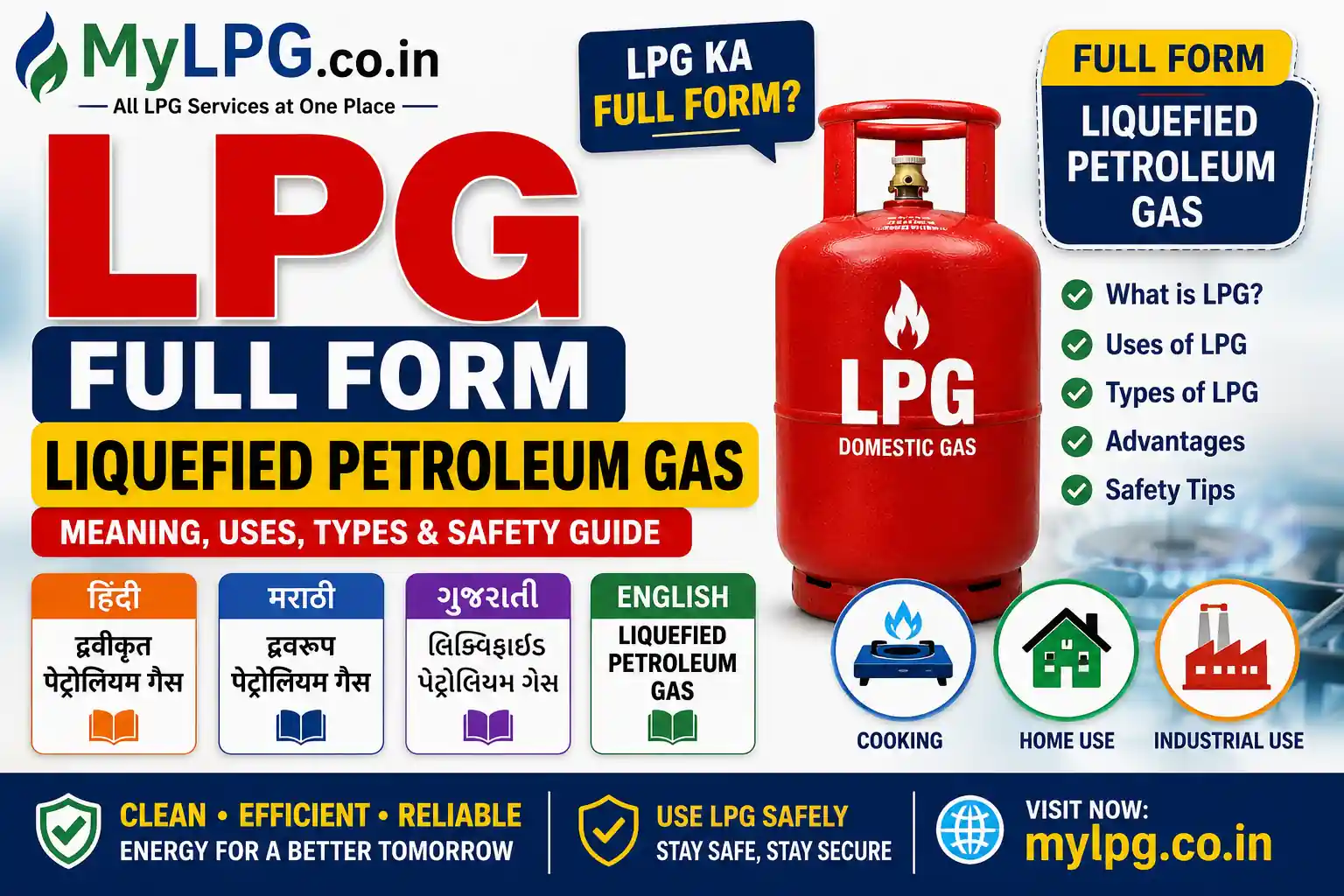
The LPG full form is Liquefied Petroleum Gas.
The abbreviation is created from the first letters:
- L – Liquefied
- P – Petroleum
- G – Gas
So, whenever you see LPG, it means Liquefied Petroleum Gas.
The term is used internationally, while LPG cylinders are particularly familiar in countries where bottled gas is widely used for household cooking.
LPG Ka Full Form Kya Hai?
Many people search online for “LPG ka full form”.
The answer is:
LPG ka full form – Liquefied Petroleum Gas
Hindi mein LPG ko:
द्रवीकृत पेट्रोलियम गैस
kaha jata hai.
LPG is commonly used in Indian households as a cooking fuel. It is supplied in cylinders through LPG distribution networks.
For consumers looking for LPG-related services, you can also check Find My LPG ID Online.
Liquefied Petroleum Gas Meaning
The name itself gives an idea about this fuel.
Liquefied
LPG can be converted into liquid form by applying pressure.
Petroleum
Its major hydrocarbon components are associated with petroleum refining and natural-gas processing.
Gas
When released from a pressurised container, LPG becomes a gas or vapour under normal atmospheric conditions.
Therefore, Liquefied Petroleum Gas essentially describes a petroleum-derived gas that is stored in liquefied form under pressure.
द्रवरूप पेट्रोलियम गॅस
In Marathi, the term commonly used for LPG is:
द्रवरूप पेट्रोलियम गॅस
The English term is:
Liquefied Petroleum Gas
This keyword is particularly relevant for Marathi-speaking users searching for the meaning or full form of LPG.
LPG is commonly used across Maharashtra and other parts of India for domestic cooking and commercial purposes.
લિક્વિફાઇડ પેટ્રોલિયમ ગેસ
In Gujarati, LPG is written as:
લિક્વિફાઇડ પેટ્રોલિયમ ગેસ
The English full form is Liquefied Petroleum Gas.
The fuel is widely recognised because domestic LPG cylinders are used for cooking in households throughout India, including Gujarat.
What Is LPG Made Of?
Liquefied Petroleum Gas mainly contains hydrocarbon gases.
The most important components are:
- Propane
- Butane
The exact composition can vary depending on the source, processing method and intended application.
These gases have high energy content, which makes LPG useful as a fuel.
How Is Liquefied Petroleum Gas Produced?
LPG is generally obtained during the processing of crude oil and natural gas.
During petroleum refining and natural-gas processing, hydrocarbon gases such as propane and butane can be separated and processed.
After processing, LPG can be stored under pressure in suitable containers.
For domestic use, the LPG is then supplied to consumers through authorised distribution networks.
Why Is LPG Stored in Liquid Form?
One of the biggest advantages of Liquefied Petroleum Gas is that it can be stored in a liquid form under pressure.
If LPG remained only as a gas, it would require much more storage space.
When liquefied, a larger amount of fuel can be stored inside a comparatively compact cylinder.
When the valve is opened, the pressure falls and LPG vaporises.
This makes LPG practical for:
- Household cooking
- Restaurants
- Hotels
- Commercial kitchens
- Heating
- Industrial applications
Uses of Liquefied Petroleum Gas
Liquefied Petroleum Gas has many uses.
1. Household Cooking
This is the most familiar use of LPG in India.
Domestic LPG cylinders provide fuel for gas stoves used for everyday cooking.
2. Restaurants and Hotels
Commercial kitchens often use LPG because it provides controllable heat and can be supplied through cylinders or suitable storage systems.
3. Industrial Applications
LPG can be used for heating and various industrial processes.
4. Commercial Heating
Some businesses use LPG for heating applications where a suitable fuel supply is required.
5. Automotive Applications
LPG-based automotive fuel can be used in certain vehicles and systems where permitted and properly installed.
LPG Cylinder: How Does It Work?
A domestic LPG cylinder is a pressurised container designed to store LPG safely.
Inside the cylinder, LPG is predominantly in liquid form.
When the regulator is opened, LPG travels through the regulator and hose towards the burner.
At the burner, the LPG mixes with air and burns.
The heat generated by combustion is then used for cooking.
This simple process is why LPG remains an important household fuel.
Properties of Liquefied Petroleum Gas
Some important characteristics of LPG include:
- LPG is highly flammable.
- It can be stored as a liquid under pressure.
- It becomes vapour when released.
- Pure LPG is essentially colourless.
- An odorant is added to help detect leaks.
- LPG has a high energy content.
- It should always be stored and handled properly.
Because LPG is flammable, correct handling is extremely important.
Why Does LPG Have a Strong Smell?
Many people notice a distinctive smell when they are near an LPG leak.
Pure LPG itself has very little natural odour. An odorant is added so that people can detect the presence of escaping gas more easily.
If you notice an unusual gas smell:
- Do not light a match.
- Do not smoke.
- Avoid creating sparks.
- Turn off the regulator if it is safe.
- Open doors and windows for ventilation.
- Follow your LPG supplier’s emergency instructions.
Never try to find a leak using an open flame.
Advantages of LPG
Liquefied Petroleum Gas has several practical advantages.
Convenient Storage
LPG can be transported and stored in cylinders and tanks.
Easy Transportation
Cylinders allow LPG to be supplied to locations without a piped gas network.
Controllable Flame
The burner flame can be adjusted according to cooking requirements.
High Energy Content
LPG provides a substantial amount of heat from a relatively small quantity of fuel.
Wide Range of Applications
It can be used in homes, restaurants, businesses and industries.
LPG Safety Tips
Although LPG is a useful fuel, safety should always come first.
Follow these basic precautions:
- Keep the cylinder upright.
- Keep the cylinder in a well-ventilated location.
- Keep combustible materials away from the burner.
- Check the LPG hose periodically.
- Turn off the regulator when the appliance is not being used.
- Do not modify the cylinder or regulator.
- Do not attempt DIY repairs on LPG equipment.
- Keep children away from the cooking area.
- Never expose the cylinder to excessive heat.
For LPG consumers, checking the correct connection and consumer information is also important. You can read LPG KYC Status Check for related information.
LPG vs Natural Gas
LPG and natural gas are different fuels.
| Feature | Liquefied Petroleum Gas | Natural Gas |
|---|---|---|
| Common Name | LPG | Natural Gas |
| Main Components | Propane and Butane | Mainly Methane |
| Storage | Pressurised cylinders/tanks | Usually pipelines or compressed systems |
| Household Use | Cooking and heating | Cooking and heating |
| Typical Cylinder Use | Common | Not the normal household setup |
Therefore, a domestic LPG cylinder should not be confused with a piped natural-gas connection.
Is Liquefied Petroleum Gas Renewable?
Conventional Liquefied Petroleum Gas is generally considered a non-renewable fossil fuel because its primary components are obtained from petroleum and natural-gas processing.
There are also developments involving renewable and bio-based gases, but conventional LPG used for household cooking is generally associated with fossil-fuel processing.
Is LPG Safe for Home Cooking?
LPG can be safely used for home cooking when the cylinder, regulator, hose and appliance are installed and maintained correctly.
The important thing is to follow the safety instructions provided by the LPG supplier and avoid modifying any LPG equipment.
A suspected leak should always be treated seriously.
For LPG booking-related information, see Gas Booking Number.
Frequently Asked Questions About Liquefied Petroleum Gas
The full form of LPG is Liquefied Petroleum Gas.
LPG ka full form Liquefied Petroleum Gas hai. Hindi mein ise द्रवीकृत पेट्रोलियम गैस kaha jata hai.
Liquefied Petroleum Gas is mainly used for cooking, heating, commercial applications and certain industrial purposes.
LPG can be stored as a liquid under pressure, allowing more fuel to be kept in a relatively small cylinder or tank.
The primary components of LPG are generally propane and butane.
Final Words
Liquefied Petroleum Gas (LPG) is an important fuel used around the world and is especially familiar in India because of domestic LPG cylinders.
The LPG full form is Liquefied Petroleum Gas, while LPG ka full form in Hindi refers to द्रवीकृत पेट्रोलियम गैस. In Marathi, it is commonly written as द्रवरूप पेट्रोलियम गॅस, while Gujarati users may search for લિક્વિફાઇડ પેટ્રોલિયમ ગેસ.
LPG can be stored as a liquid under pressure and changes into vapour when released. Its main components are generally propane and butane, making it an efficient fuel for cooking and other applications.
Understanding the meaning, uses and safety requirements of LPG can help consumers use their gas connection more responsibly.
Read Also
- Find My LPG ID Online
- LPG KYC Status Check
- LPG Gas Booking Online
- Gas Booking Number
- LPG Cylinder Delivery Not Received
- LPG Gas Connection Transfer Online