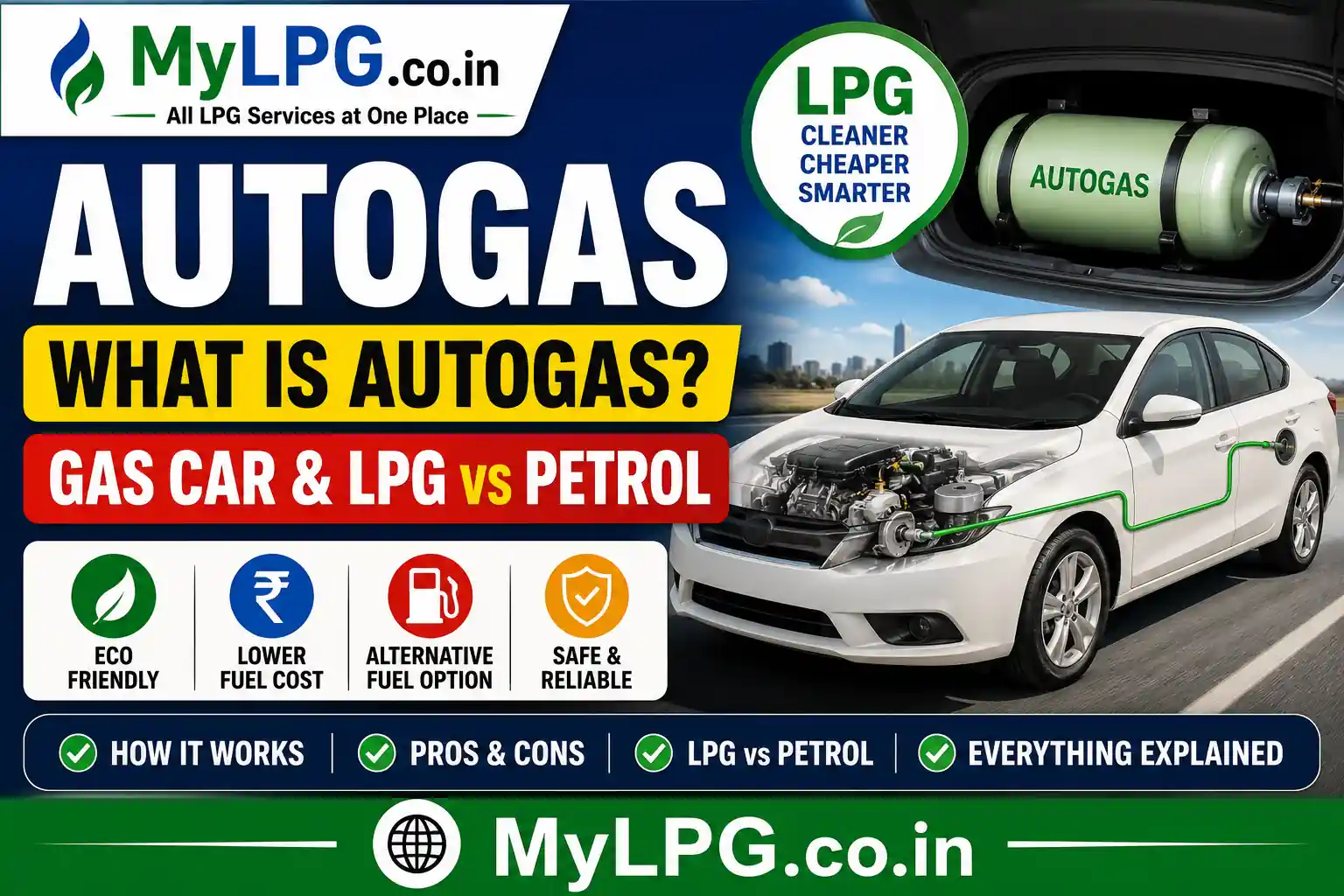
Autogas is liquefied petroleum gas (LPG) used as a fuel for motor vehicles. The term is commonly used for automotive LPG, which is primarily made up of propane and butane and is stored under pressure in a specially designed vehicle fuel tank.
People searching for “what is autogas”, “gas car”, and “LPG vs petrol” are generally looking to understand how LPG can be used as a vehicle fuel and whether it can be an alternative to petrol.
In this guide, we explain what Autogas is, how a gas car works, the difference between LPG and petrol, and the advantages and limitations of automotive LPG.
Note: MyLPG.co.in is an independent informational website. It is not an official government or LPG company website.
What Is Autogas?
Autogas means LPG used as an automotive fuel.
LPG stands for Liquefied Petroleum Gas. It is stored as a liquid under pressure and supplied to an engine through a dedicated automotive fuel system.
Autogas can be used in compatible:
- Cars
- Taxis
- Vans
- Fleet vehicles
- Commercial vehicles
- Other LPG-compatible vehicles
The vehicle needs an appropriate LPG fuel system. A normal household LPG cylinder should never be used as a substitute for an automotive LPG system.
If you are interested in household LPG rather than vehicle fuel, you can also read our guide to LPG Cylinder Price in India.
What Is Autogas Fuel?
Autogas fuel is automotive LPG used to power compatible vehicles.
The basic process is:
LPG tank → Fuel system → Air/fuel mixture → Engine combustion → Vehicle power
The LPG is stored in a specially designed tank. The vehicle’s fuel system controls the fuel supply and delivers it to the engine in the required form.
Some LPG vehicles are dual-fuel vehicles, meaning they can run on both LPG and petrol.
What Is a Gas Car?
A gas car is a vehicle that uses a gaseous fuel instead of, or in addition to, conventional petrol or diesel.
The term can refer to different types of vehicles, including:
- LPG cars
- CNG cars
- Other alternative-fuel vehicles
In the context of Autogas, a gas car generally means an LPG-powered vehicle.
An LPG vehicle normally has a dedicated tank, fuel lines, valves and other components designed specifically for automotive LPG.
How Does an Autogas Car Work?
An Autogas-powered car works on the same basic internal-combustion principle as many petrol vehicles.
1. LPG is stored in the tank
Autogas is stored as a liquid under pressure in a purpose-built vehicle tank.
2. Fuel moves through the LPG system
The vehicle’s fuel system controls the movement of LPG from the tank toward the engine.
3. LPG is prepared for combustion
The system regulates the fuel and combines it with air in the required proportion.
4. The engine burns the mixture
The LPG-air mixture is ignited inside the engine to produce energy.
5. The engine powers the vehicle
The energy produced during combustion is converted into mechanical power that moves the vehicle.
LPG vs Petrol: What Is the Difference?
The LPG vs petrol comparison is important for anyone considering an alternative vehicle fuel.
| Feature | LPG / Autogas | Petrol |
|---|---|---|
| Fuel type | LPG | Liquid petroleum fuel |
| Storage | Pressurised tank | Conventional fuel tank |
| Vehicle compatibility | Requires LPG-compatible system | Standard petrol system |
| Energy per litre | Lower than petrol | Higher than LPG |
| Fuel consumption | Usually higher by volume | Usually lower by volume |
| Refuelling availability | Depends on location | Generally widely available |
| Conversion | Possible for compatible vehicles | Not required |
| Running cost | Depends on local LPG price | Depends on petrol price |
The important point is that LPG and petrol are different fuels. A petrol vehicle cannot simply be filled with LPG without an appropriate LPG fuel system.
Is LPG Cheaper Than Petrol?
It depends on the local prices and the vehicle’s actual fuel consumption.
LPG generally contains less energy per litre than petrol, so an LPG vehicle may consume more litres over the same distance.
However, if LPG is significantly cheaper per litre, the overall running cost can still be lower.
For a proper comparison, calculate:
Fuel cost per kilometre = Fuel price ÷ Kilometres per litre
For example, if a car travels 12 km per litre on petrol at ₹100 per litre:
₹100 ÷ 12 = ₹8.33 per km
If the same car travels 10 km per litre on LPG at ₹70 per litre:
₹70 ÷ 10 = ₹7 per km
In this example, LPG has a lower fuel cost per kilometre.
LPG vs Petrol: Which Is Better?
There is no single answer for every driver.
LPG may be attractive when:
- LPG is easily available locally.
- Autogas is substantially cheaper than petrol.
- The vehicle is compatible with LPG.
- You drive enough kilometres to justify the conversion cost.
- Suitable LPG maintenance facilities are available.
Petrol may be more convenient when:
- LPG stations are difficult to find.
- You frequently travel to areas without LPG refuelling.
- You do not want the additional LPG equipment.
- Your vehicle is not suitable for LPG conversion.
Therefore, compare total running cost and convenience, rather than only the price of one litre of fuel.
Advantages of Autogas
Autogas can provide several benefits for compatible vehicles.
Lower Fuel Cost in Some Locations
Where automotive LPG is priced below petrol, drivers may be able to reduce their fuel expenditure.
Dual-Fuel Option
Some LPG vehicles can switch between LPG and petrol.
Established Technology
Automotive LPG systems have been used in different countries for many years.
Alternative to Petrol
For compatible vehicles, Autogas provides another fuel option instead of relying entirely on petrol.
Disadvantages of Autogas
Autogas also has some limitations.
LPG Stations May Be Limited
Availability depends heavily on the region.
Higher Fuel Consumption by Volume
Because LPG has lower energy density per litre, a vehicle may need more litres to travel the same distance.
Conversion Cost
Converting a petrol vehicle to LPG requires suitable equipment and professional installation.
Additional Maintenance
The LPG system needs appropriate inspection and maintenance.
Space for the Tank
Depending on the vehicle and tank design, the LPG tank can affect available luggage space.
Is Autogas the Same as Cooking LPG?
Autogas and household LPG are both based on Liquefied Petroleum Gas, but they are used for different purposes.
Autogas is intended for vehicles and must be used through an appropriate automotive LPG system.
Household LPG is supplied for cooking and other domestic applications.
Therefore, a household LPG cylinder should not be connected to a car or used as an automotive fuel source.
Can a Petrol Car Be Converted to LPG?
Some petrol vehicles can be converted to LPG, but not every vehicle is automatically suitable.
Before conversion, vehicle owners should check:
- Engine compatibility
- Approved LPG equipment
- Local regulations
- Installation requirements
- Registration requirements
- Availability of qualified technicians
- Long-term maintenance costs
An LPG conversion should always be carried out using appropriate equipment and by a qualified professional.
Autogas vs CNG
Autogas and CNG are often grouped together because both can be used as vehicle fuels, but they are different.
| Feature | Autogas | CNG |
|---|---|---|
| Full form | Liquefied Petroleum Gas | Compressed Natural Gas |
| Main fuel components | Mainly propane and butane | Mainly methane |
| Storage | Liquid under pressure | Compressed gas |
| Vehicle fuel | Yes | Yes |
| Fuel system | LPG-specific | CNG-specific |
| Refuelling network | Depends on location | Depends on location |
An LPG vehicle and CNG vehicle require different fuel systems.
Autogas Running Cost
The best way to determine whether Autogas is economical is to calculate the cost per kilometre.
Consider these factors:
- LPG price
- Petrol price
- Vehicle mileage on each fuel
- Annual kilometres
- Conversion cost
- Maintenance cost
- Availability of refuelling stations
For someone driving many kilometres every month, even a small saving per kilometre can become significant over a year.
Autogas in India
In India, LPG is widely used as a household cooking fuel, while CNG is more commonly associated with automotive applications in many cities.
The availability of automotive LPG can vary by location. Anyone considering an LPG vehicle should first check the availability of appropriate refuelling facilities in their area.
For household LPG information, you can also read:
- LPG Price in Delhi 2026 – Indane, Bharat Gas & HP Gas Rates
- LPG Cylinder Price 2026 – Latest LPG Rates
Autogas vs Petrol: Quick Comparison
| Question | Autogas | Petrol |
|---|---|---|
| Can it power a car? | Yes, with a compatible LPG system | Yes |
| Fuel cost | Depends on local price | Depends on local price |
| Mileage per litre | Generally lower | Generally higher |
| Conversion required? | For converted vehicles, yes | No |
| Fuel availability | Location dependent | Generally high |
| Suitable for every car? | No | Petrol cars are designed for it |
Frequently Asked Questions
Autogas is LPG used as a fuel for vehicles. It is stored under pressure and supplied through an automotive LPG fuel system.
Autogas is used to power compatible cars, taxis, vans and other vehicles.
A gas car is a vehicle that uses a gaseous fuel such as LPG or CNG. An LPG gas car uses Autogas as its vehicle fuel.
It can be cheaper depending on local fuel prices and vehicle consumption. The best comparison is the cost per kilometre.
Autogas is the term commonly used for LPG when it is supplied and used as an automotive fuel.
It depends on fuel prices, vehicle compatibility, driving distance, refuelling availability and maintenance costs.
Related LPG Guides
For more LPG information, continue with these related guides:
- LPG Price in Delhi 2026 – Check Indane, Bharat Gas and HP Gas rates.
- LPG Cylinder Price 2026 – Latest LPG cylinder price information.
- Liquefied Petroleum Gas – LPG Full Form & Meaning – Learn what LPG means and how it is used.
- Find My LPG ID Online – Learn how to find your LPG ID.
- LPG Subsidy Status Check – Information about checking LPG subsidy status.